
Introduction: A Market Ready for Refinement
When a friend introduced me to an etiquette coach in Mexico, I saw an incredible opportunity.
She had over 400K Instagram followers and 1.3M TikTok followers, a couple of online courses, and a high-ticket program.
Yet, despite her impressive following, her sales weren’t scaling as expected.
She wanted to expand her business but didn’t know how to position her offers effectively. That’s where I stepped in.
Understanding the Market & Its Resistance
The first step was researching her audience and existing products.
I analyzed what she had sold before, what had stopped selling, and how her community engaged with her content.
One major challenge stood out: Many people on TikTok viewed etiquette as outdated and elitist.
Even those who appreciated her content were hesitant to engage openly, influenced by the negativity surrounding the subject.
If we wanted to increase sales, we needed to reposition etiquette—not as a rigid set of rules, but as a tool for confidence, influence, and self-worth.
But how did I find the right angle?
I dove into her eBooks and course materials, and even immersed myself in her world to better understand what I was actually selling, searching for hidden gems that could reshape her messaging.
Instead of simply selling “etiquette,” we highlighted personal transformation, self-mastery, and leadership—concepts that resonated more deeply with her audience.
I also realized her book titles were not marketable. They didn’t reflect the deeper values within.
So, I rebranded and repackaged her books into a low-ticket bundle as a proposal, designed to generate revenue while also serving as an entry point for new customers.
Packaging & Positioning the Offer
To create a sustainable sales funnel, I structured her offerings in a pyramid of interest:
- Low-ticket eBook bundle: A compelling, affordable entry product.
- Mid-ticket courses: More in-depth training for committed learners.
- High-ticket academy program: A premium experience for those seeking mastery.
With this structure, we used profits from low-ticket sales to fund lead generation for high-ticket conversions.
Crafting the Ads: 50+ Variations to Test
Using what I had learned about her audience, I created over 50 ad variations testing different:
- Creatives (videos, carousels, images)
- Headlines (focused on transformation, empowerment, and influence)
- Body copy (connecting etiquette to personal and professional success)
I also expanded her reach to men, something she had wanted to do but hadn’t figured out how. By framing etiquette as a tool for character building, influence and leadership, we made it appealing beyond just women.
I literally had to apply table etiquette principles in my own daily life to truly grasp their value. It was both an interesting and frustrating experience—but one that taught me something important.
The Results: A Scalable Success
The results spoke for themselves:
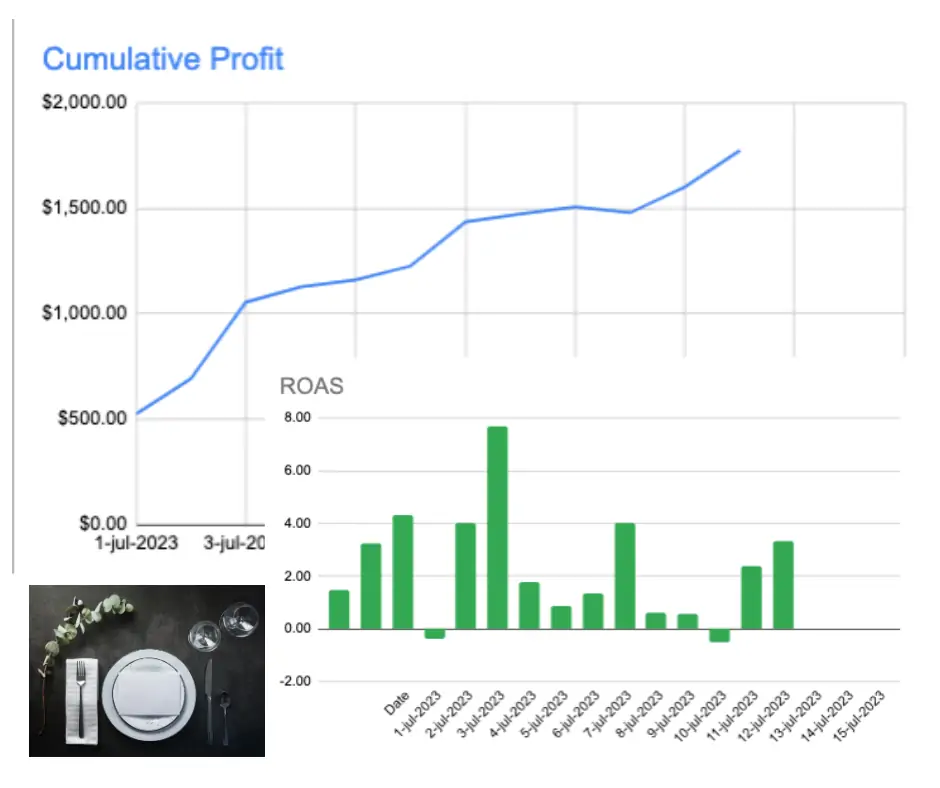
- ROAS of 3.19 from the start (profitable from day one)
- Cost per lead: $0.62 (targeting Latin American markets: Mexico & Colombia)
- Total revenue: $25K+ from high-ticket sales
- Initial ad spend: $700 (but direct sales from low-ticket products recovered $1,600, making the investment zero-risk)
Final Thoughts: The Power of Commitment
This project reinforced something I strongly believe in: A great work doesn’t just consist in running ads—but to build real strategies based on meticulous homework.
The secret to success wasn’t just spending money on ads. It was deeply understanding the audience, reshaping the brand message, and positioning the offer in a way that made sense.
Full disclosure: These kinds of results were more achievable thanks to her large audience. Converting followers into buyers is a quicker process than dealing with cold publics.
However, for businesses looking to scale, the key takeaway is always the same: Know your market, refine your message, build a structured sales funnel, and bring them something “new” to the table. This experience was a great reminder of how psychology and marketing go hand in hand—and how the right strategy can turn an audience into a thriving business.
Leave a Reply